2026 Gold Award winner announced
Published on 10 July 2026
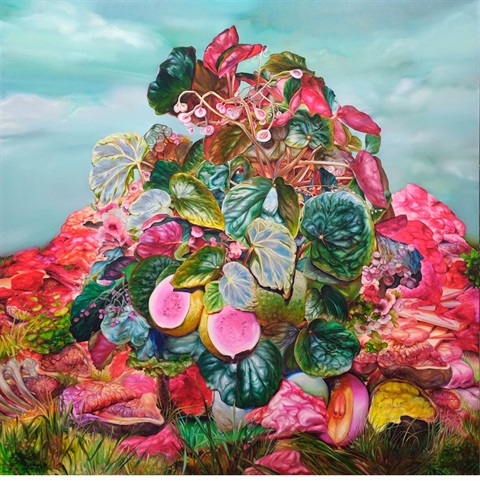
No time wasted announcing the 2026 Gold Award winner
The winner of Rockhampton Museum of Art's (RMOA) 2026 Gold Award has been announced, with the prestigious acquisitive award recognising outstanding contemporary Australian art.
The winning artwork was selected from a total of 21 works by eight acclaimed artists whose practices represent some of the most exciting voices in contemporary Australian painting. Making the final decision was esteemed artist Jenny Watson, one of Australia's most influential contemporary practitioners, whose celebrated career has spanned more than 40 years.
Gold Award judge Jenny Watson said selecting this year's winner from the exhibition was a challenging task before announcing Karla Marchesi as the recipient of the 2026 Gold Award.
“The winner of the Gold Award 2026 is an artist of extraordinary dexterity and vision. Her work demonstrates a sophisticated contemporary practice that reaches across history, drawing on artistic traditions to create paintings that are both compelling and hypnotic. Having successfully navigated the significant transition of relocating to Europe, she has continued to build an impressive international career while maintaining a distinctive artistic voice. It is my great pleasure to announce that Karla Marchesi is the recipient of the 2026 Gold Award for her work, Wasted Waiting.”
Winning artist Karla Marchesi was honoured to be invited to submit works for this prestigious invitational art award.
“Receiving the 2026 Gold Award is such a career coup. To get that level of recognition, and to be invited alone, was really special.”
“I was looking forward to just showing my work at the Rockhampton Museum of Art more than anything else. That’s really meaningful to me, but to receive this award is a gift of freedom that enables me to really indulge in my practice.”
Rockhampton Regional Council Chair of Communities, Culture and Heritage Portfolio, Councillor Drew Wickerson said The Gold Award continues to be a highlight of the region's cultural calendar.
“The Gold Award continues to be one of the most anticipated events on Rockhampton’s arts and culture calendar, attracting some of Australia’s most accomplished contemporary artists and further strengthening the reputation of Rockhampton Museum of Art,” Cr Wickerson said.
“I congratulate our 2026 Gold Award winner on this outstanding achievement. Their work now joins a collection of nationally significant artworks that tell the story of contemporary Australian art and can be enjoyed by our community and visitors alike.”
“Each acquisition strengthens the RMOA Collection and helps ensure Rockhampton remains home to one of the country's leading regional art collections.”
“The Gold Award is about more than recognising artistic excellence; it is also about building a lasting cultural legacy for future generations and providing access to remarkable works of art right here in our region.”
“We also acknowledge and thank the 2026 Gold Award Donors, whose significant contributions enable the collection to continue growing beyond the winning acquisition.”
“Through the generosity of these benefactors, Rockhampton Museum of Art will be able to acquire additional works from this year's exhibition, ensuring more exceptional artworks are preserved within the collection for future generations to experience and enjoy.”
Rockhampton Museum of Art Acting Director Shanna Muston was impressed with the remarkable range of artistic voices and perspectives presented by this year’s invited artists.
“Each iteration, The Gold Award adds a significant new chapter to the Rockhampton Museum of Art Collection, and we are delighted to welcome this year’s winning work into that legacy,” Ms Muston said.
“The calibre of artists and artworks presented in the 2026 exhibition has been exceptional. I’m sure selecting a winner from such a distinguished group of finalists was no easy task, and we congratulate both the winning artist and all finalists for their outstanding contributions.”
“It is a privilege to bring contemporary Australian painting to audiences in Rockhampton and to continue building a collection of national significance through the vision of Moya Gold and the generosity of our Gold Donors. I encourage the community come along to RMOA to enjoy this incredible exhibition.”
About the Gold Award
Established in 2012, The Gold Award is Queensland’s richest painting prize and has become a significant platform for contemporary Australian art. Named in honour of the late Rockhampton philanthropist Moya Gold, the biennial acquisitive award was created through her generous bequest and continues her vision of supporting the growth of Rockhampton Museum of Art’s collection.
The recipient of The Gold Award receives a $50,000 prize, with the winning artwork becoming part of the Rockhampton Museum of Art Collection, further strengthening one of regional Australia's most important collections of contemporary art.
The Gold Award is proudly presented through a partnership between Rockhampton Museum of Art, the Rockhampton Museum of Art Philanthropy Group and Rockhampton Regional Council, with the ongoing support of donors whose generosity ensures the continued growth of the Collection for future generations.
The Gold Award 2026 exhibition will be on display to the public at Rockhampton Museum of Art from 4 July to 6 September. Entry is free.
Owned and operated by Rockhampton Regional Council, Rockhampton Museum of Art remains committed to delivering high-quality exhibitions and cultural experiences that connect audiences with contemporary art and ideas.
Exhibition Details
Exhibition Dates: 4 July – 6 September 2026
Location: Rockhampton Museum of Art – Gallery 1
Entry: Free
Find out more information here.
2026 Gold Award Winning Artist | Karla Marchesi
In a spirited Baroque-punk adaptation of Romanticism, my work refracts the socio-cultural anxieties of our age, critiquing what it means to be human in this present moment under the conditions of late capitalism and Anthropocentrism. My practice entwines autobiographical narrative with broader ideological critique, drawing on bathos, pathos, and the deliberate absence of the human figure to address both intimate and existential concerns. My visual language utilises density, ornament, irreverence, and chaos to subvert the sublime. The absence of the figure positions the botanical as an anthropomorphic stand-in for the human: a silent witness reflecting ourselves back to ourselves.
With an air of affirmative nihilism and tragicomic melodrama, my paintings stage heightened emotional landscapes, often featuring complex entanglements of multi-genus flora and fauna in hyper-natural, post-humanist scenes. A Lacanian understanding of desire—too much is never enough—is expressed pictorially through an overabundance of forms and painterly details, proliferating species, excessive ornamentation, and sensory overload.
Through an art-historical lens and maximalist compositional tropes, the work becomes a decadent visual feast that, if consumed in one sitting, may induce a kind of dizzying nausea.
Positioned between seduction and repulsion, my botanical subjects function as potent allegories—sensuous yet critical—underscoring the complexities, contradictions, violence, and vulnerability of our modern age. They sit in delicate tension between surface and substance, desire and decay, delight and disillusionment, while touching on the enduring human longing for hope and connection.
For over a decade, my practice has drawn from and reimagined the “Impossible Bouquet” genre of 17th-century Dutch still life painting. I present non-human subjects as heroic, embodied with agency and generative possibility, subverting traditions of the genre and highlighting human folly, especially my own. Resistant, adaptive, and at times indifferent, these non-human ontologies invite viewers to consider our shifting relationship to the world.
- Karla Marchesi
Text courtesy of the artist
Image Caption: Karla Marchesi, Wasted Waiting 2025, oil on linen, 165 x 165 cm. Courtesy of the artist, Jan Manton Gallery, Brisbane and Nicholas Thompson Gallery, Melbourne